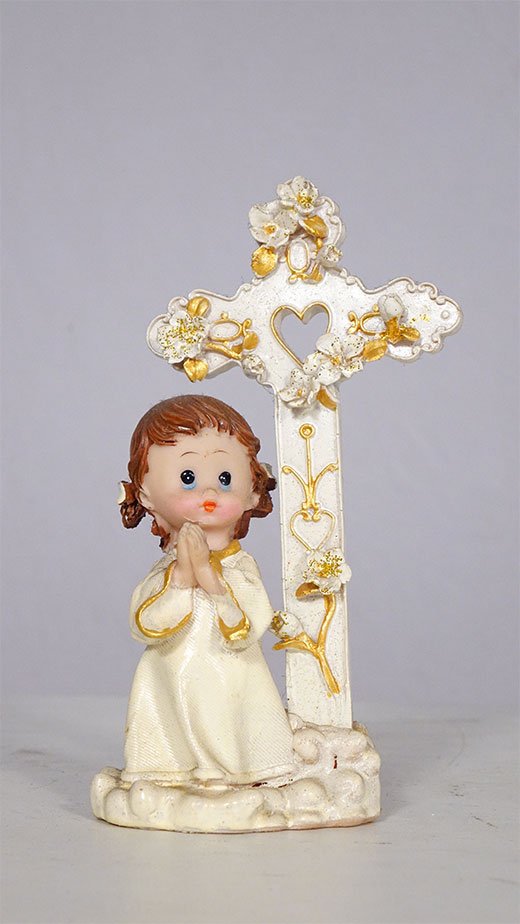
What a Holy Family Statue Really Means to Your Home
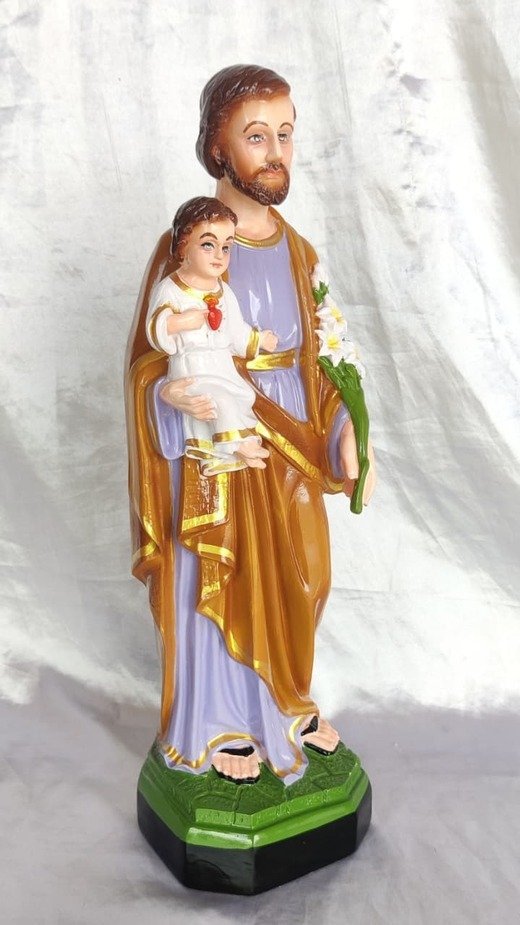
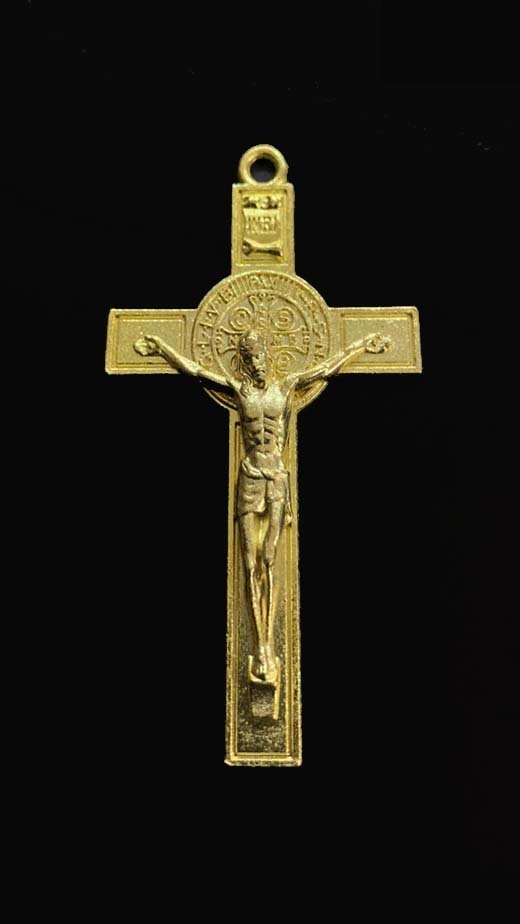
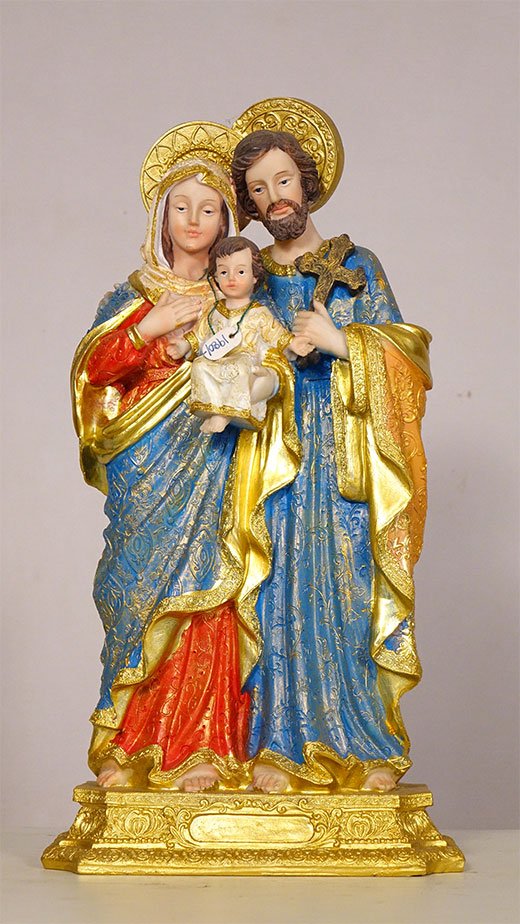
A holy family statue isn’t just decoration—it’s a visual reminder of faith. Whether placed on a shelf, altar, or nightstand, it anchors prayer and reflection in your daily environment. For those exploring Christian devotional items like rosaries, crucifixes, and church articles, a Christian holy family statue creates a cohesive spiritual atmosphere.
The Holy Family—Mary, Joseph, and Jesus—represents protection, unconditional love, and family unity. These aren’t abstract concepts but lived values that resonate with adults seeking deeper spiritual meaning in their homes.
Finding Your Style and Size
Sizing matters. A 6-inch holy family statue fits shelves and desks. A 12-inch piece works as a focal point on prayer tables. Measure your intended space and add six inches—that’s your realistic placement zone.
Style varies significantly. Traditional depictions show Mary and Joseph protecting the Christ Child. Contemporary versions offer bolder, simpler arrangements. Your home’s aesthetic should guide this choice. Cottage settings suit wooden pieces; modern spaces often pair better with sleek materials.
Materials Matter More Than You Think
Poly marble offers refinement and durability. Plastic or resin provides affordability and lightweight handling. Wood brings warmth but needs occasional care to prevent cracking. Choose based on where your holy family décor statue will live and how much maintenance you’re willing to give.
Glazed finishes catch light and work in bright rooms. Matte finishes blend into softer lighting. This small detail shapes how your piece integrates into your space.
Where to Find Quality Holy Family Décor Statues
Lacorona operates as a Christian online store with over 40 years of experience. Their collection of holy family statues reflects deep understanding of Christian devotional items. They offer various materials, sizes, and styles—meaning you choose based on genuine preference, not limited availability.
Clear product images, accurate dimensions, material information, and straightforward return policies let you shop with confidence. Their filtered browsing by size, material, and design saves time and prevents regrettable purchases.
Setting Up Your Spiritual Space
A holy family statue deserves thoughtful placement. Lighting transforms presence—a nearby lamp makes even modest pieces glow with intention. Pair your statue with related devotional items like rosaries or crucifixes to create an informal altar without clutter.
Basic maintenance keeps pieces beautiful for decades. Gentle dusting, avoiding extreme temperature changes, and protecting painted surfaces from direct sun ensures longevity.
Bottom Line: Choosing a holy family statue is about recognizing what draws you spiritually. Measure your space, clarify your style, and select from retailers like Lacorona who understand Christian homes. The right piece transforms an empty corner into a point of faith.
There’s a particular feeling when a Jesus statue for home is placed just right in a room. It’s not loud. It doesn’t demand attention. But it’s there — quietly present during morning prayers, during hard conversations at the dining table, during ordinary evenings. That kind of presence is worth thinking about before buying.
Most people make the mistake of picking a statue based purely on how it looks in a photograph. That’s understandable, but a devotional object carries more weight than that. The form of Christ depicted, the size, the material, the placement in your home — all of it contributes to whether the statue actually deepens your prayer life or simply becomes background furniture.
“A statue you connect with spiritually will outlast a dozen you chose only for aesthetics.”
What Type of Jesus Statue Suits Your Home?
This is the question people skip straight past, and they shouldn’t. There’s no single “correct” answer — the right choice depends on your own devotion and what aspect of Christ you hold most dear. Here’s a practical breakdown of the main forms available:
Type
What It Represents
Suited For
Sacred Heart Jesus
The love and mercy of Christ
Living rooms, family prayer corners
Infant Jesus
Trust, humility, childhood of Christ
Children’s rooms, nurseries, Christmas altars
Divine Mercy
Forgiveness, God’s boundless mercy
Bedrooms, personal prayer spaces
Christ the Redeemer
Protection, arms open wide
Entranceways, main halls
Christ the King
Sovereignty and lordship of Christ
Study rooms, home offices
Meditation Statue of Jesus
Contemplation, quiet prayer
Personal prayer corners, chapels
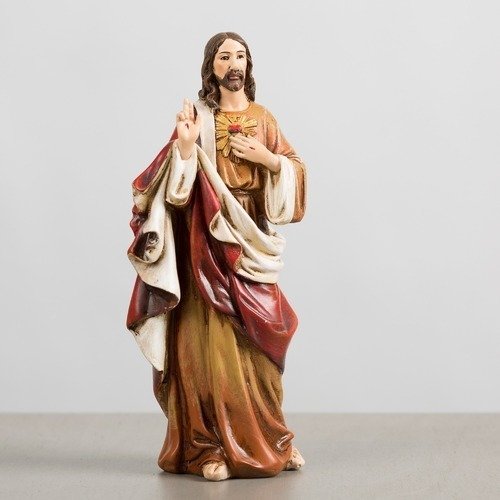
The Sacred Heart Jesus statue remains one of the most widely chosen forms for Indian Catholic homes. It carries a warmth that feels right in the heart of a family space. But if your prayer life is more centred on seeking forgiveness or intercession, a Divine Mercy statue or an Infant Jesus might resonate more deeply.
Size and Placement: Getting It Right
Think About the Space First
A large, detailed statue can look imposing in a small bedroom. A small figure gets lost in a wide hallway. Before you decide on a piece, measure the shelf, niche, or surface where it will sit. A statue that anchors a home altar will need a different scale than one placed on a bedside table.
For a personal prayer corner or bedroom, 6 to 10 inch statues work well
For a living room altar or main display, 12 to 18 inch sizes create a proper focal point
For a car, small car statues or car stands are specifically designed for dashboard or visor placement
Entryways benefit from taller statues that can be seen clearly from a distance
Placement and Direction
Traditionally, many Christian families place the statue in the eastern direction of the home or on a dedicated altar shelf. There’s no rigid rule in Catholic tradition, but the principle is the same everywhere: the statue should be visible, accessible, and not tucked away like an afterthought. It should invite prayer, not require searching for it.
Does the Material Matter?
Short answer: yes, more than people think. The material affects not just appearance but durability and the overall feeling the statue gives a room.
Poly marble statues, for instance, have a weight and solidity to them that cheaper plastic simply cannot replicate. The finish tends to be smoother, the details crisper. If you’re placing a statue in a permanent home altar, poly marble or similar dense materials hold up far better over years of use. Plastic statues are a practical option for children’s rooms or for gifting, where durability over time is less of a concern. Some people also prefer fiber statues for their lighter weight when larger sizes are needed.
The honest opinion here: if this is a statue you’ll pray before every day, it’s worth investing in a material that reflects that intention.
Pairing the Statue with Other Devotional Items
A Jesus statue for home rarely stands alone in a well-kept prayer space. The fuller the devotional environment, the more it supports consistent prayer. Think about what surrounds the statue — not to clutter the space, but to complete it.
A crucifix placed above or near the statue grounds the space in the central symbol of the faith
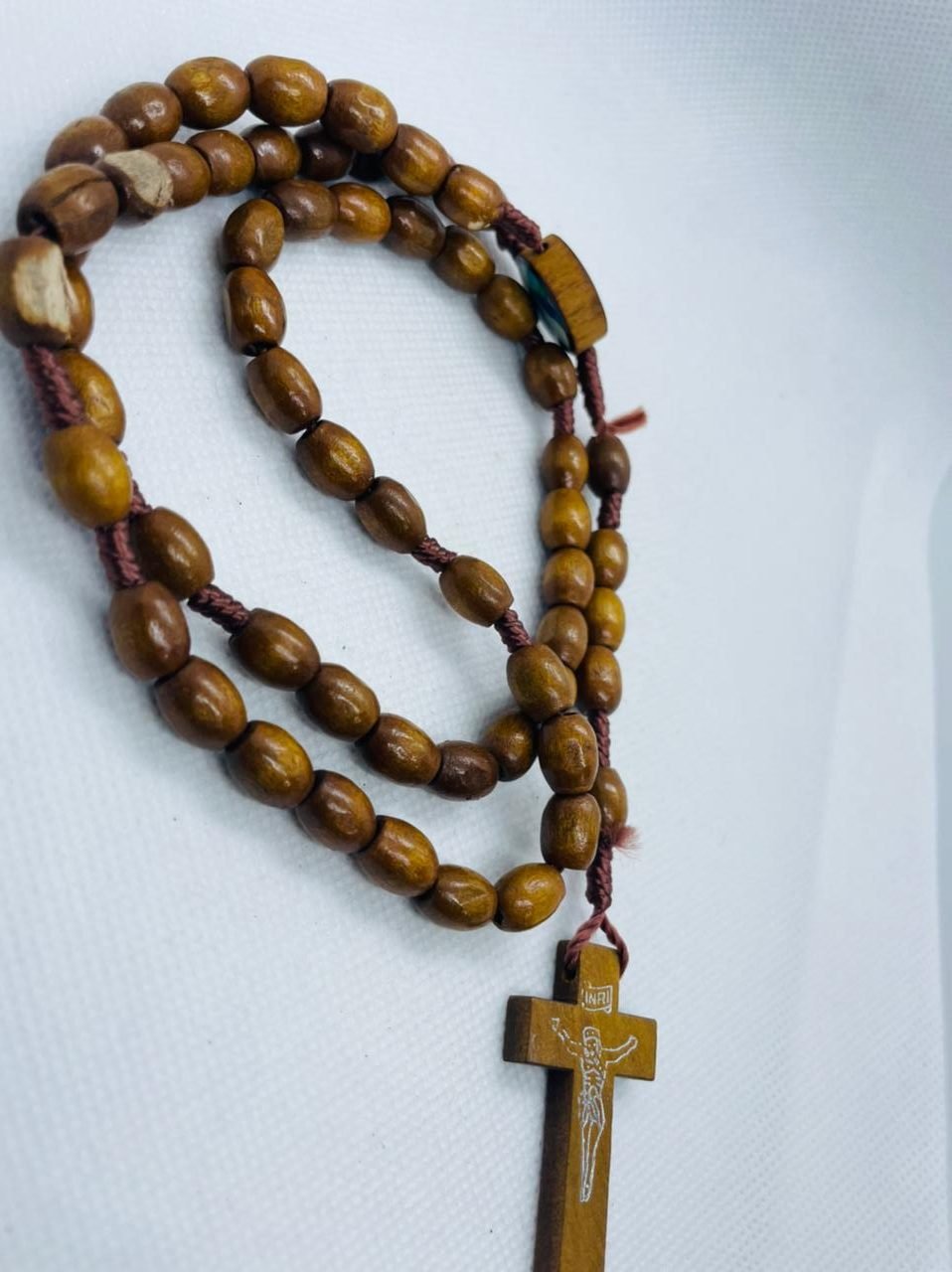
A rosary resting near the statue serves as a daily reminder and a ready tool for prayer
Candles — whether wax, gel, or LED — add the right kind of atmosphere to a home altar without overpowering it
A small holy water hanging near the door of the room is a simple, traditional touch
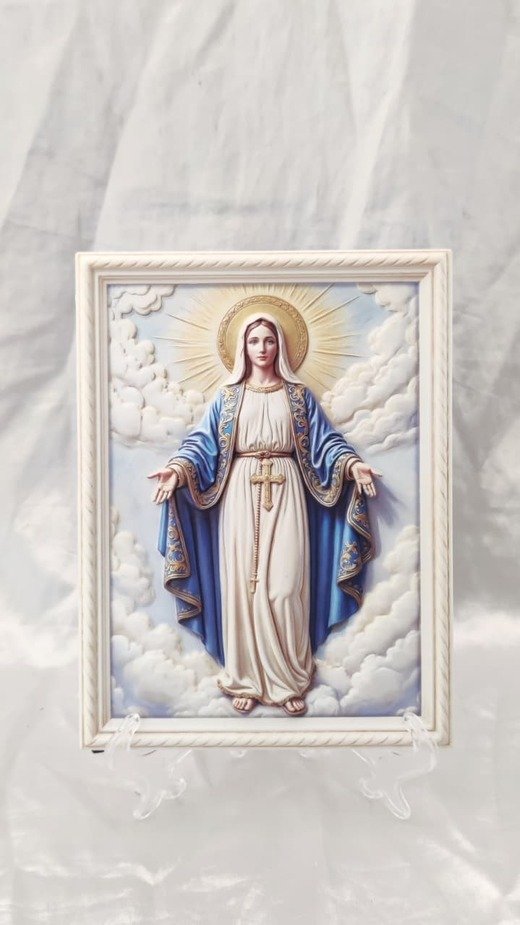
Photo frames of sacred images — Divine Mercy, the Last Supper, the Holy Family, work well on the wall above or beside a statue
This kind of layered devotional environment is something many families build gradually. There’s no need to set it up all at once. Add pieces that carry personal meaning as you find them.
Where to Find Reliable Religious Statues for Home
Finding quality religious statues for home in India used to mean travelling to a specific church goods shop — often far, often limited in selection. That’s changed considerably.
Lacorona(La Corona Del Rosario), based in Koonammavu, Kochi, is one of the more comprehensive Christian devotional stores available online in India, with over 40 years of service in this space. Their statue collection covers the full range of Jesus forms, Sacred Heart, Infant Jesus, Divine Mercy, Christ the Redeemer, Christ the King, the Meditation Statue, Risen Jesus, and more, across multiple sizes and materials including poly marble and fiber.
What makes browsing Lacorona particularly practical is that the Christian devotional items go well beyond statues. Rosaries, crucifixes, candles and candle stands, holy water hangings, photo frames, church articles — it’s possible to put together an entire home altar from one source, which removes a lot of the difficulty in finding matching pieces. Wholesale options are also available for parishes and institutions.
Reviews from customers consistently mention the range of designs and the quality of what arrives, which, for devotional objects ordered online, matters more than most people realise until something disappoints them.
Explore Jesus Statues at Lacorona
Browse a wide range of Sacred Heart, Infant Jesus, Divine Mercy, Christ the King, and more — across sizes and materials, with delivery across India.Shop Jesus Statues →
In Christian worship, a candle is often used as a symbol of the light of God. It can also be used to decorate the walls and enhance the ambiance. The lighting of candles has become a symbolic gesture at many Christian churches, where worshippers will light candles as a sign of remembrance for a loved one who has passed as well as during a part of services like a Mass. Clergy often relates the candle as representing Jesus as the Light of the world and also as representing God’s presence and power. Now, what is the difference between church candles and votive candle stands? While visiting a Christian store you might have stumbled upon plenty of candle varieties but what makes each of them different? Let’s take a look: Firstly, the candle stands used in churches are called votive stands and the term refers to something that is consecrated or offered in fulfillment of a vow. It is also called a prayer candle as it represents the prayer said for someone else or for one’s self. A votive candle stand can take up different styles and sizes. It could either be a tabletop stand or a standalone piece that can be made with wood, steel, metal, fiber, crystal, or brass. At La Corona Del Rosario, one of the most popular Christian stores in Kerala, we have candle stands in all of the above mentioned materials in elegant styles.
Candles form a significant part of Catholic celebrations and rituals, and the lighting of candles plays a considerable role. They are lit during the celebration of Masses and at other times to signify God’s presence in the Blessed Sacrament in churches or chapels, or at funerals. In the Sacrament of Baptism, an individual is initiated into the Church by receiving a candle from the Paschal Candle, which symbolizes Christ’s passion, death, and resurrection. By lighting this candle, an individual receives the Light of Christ so that they may live and walk the path of God’s children and sustain that flame of faith burning alive in their heart. As they receive this indelible baptismal mark, they shall encounter the Lord and be one with all the saints in Heaven when the time comes. Now, what does the votive candle stand lighted before a statue or God’s image? It demonstrates one’s devotion and reverence for God. A lighted candle stand symbolizes a prayer offering. We present our petitions to the Lord and ask the saints to pray with us, as well as for us during our most urgent needs. This light, when kept burning in a place of prominence, represents our longing for God’s companionship as we go about our daily duties at home and in the workplace. Candles are lit at altars, usually set up as part of a religious ceremony in honour of a particular saint. Candles are also commonly lit beside images of the Sacred Heart, Mary, the Little Flower, St Joseph and others. These candles can be placed before statues of saints and other objects such as flowers or artwork. The number of candles and the placement of candle stands/candles to be lit at the primary altar differs based on the occasion and type of clergy presiding over the Mass. As per traditions, all the candles must be in place and lit before the Mass begins and they are not extinguished until the service is over.
Worshippers do keep church candles at their home while praying. You can choose from our range of candle stands and candles to complete the setup. Like we had already mentioned, the concept of light has a special significance because it represents Christ. Christ is called the “light of the world” in John 1:4 and he is associated with light imagery in John’s Gospel as well. As a result, we understand why, during the Sacrament of Baptism, a priest presents a candle that has been lit from the Paschal candle and tells the newly baptized to receive Christ’s light. And at Easter, the Paschal candle is lit as a sign of Christ’s risen light that cannot be extinguished. It shines into the world as a symbol of hope and love. A symbol of devotion, hope, prayer and a lot more, candles play a crucial role in Christianity. It needs to be maintained carefully. Our range of candles and candle stands are meticulously crafted with the best raw materials that are sourced to befit your requirements.La Corona Del Rosario has always been in the front when it comes to client satisfaction and delivering best quality Christian supplies, gifts and products. If you are in search of a reputed Christian store in Kochi, head over to our outlet in Koonamavu or Varapuzha for a seamless shopping experience.
Considered to be symbols of faith and also their identity, priest vestments have their own importance to them. In the Middle Ages, priests wore clothes that marked them as different from the commoners and royalty who would sometimes pay less attention to their attire. The clothing of priests aimed at showing the purity of their intentions hence, it had a direct effect on how people perceived their role in the community or the church.
The word “vestment” is derived from a Latin word which translates to clothing. The priest prays his “vesting prayers” while he gets vested and it is associated with or describes the symbolism of each vestment piece. This helps the priest prepare for Mass by channeling his thoughts to what will happen next and connect him to the liturgy’s history. However, the first prayer does not have any connection to the piece of clothing but it is said while the priest washes his hands. Let’s take a look at the significance of priest vestments, one by one:
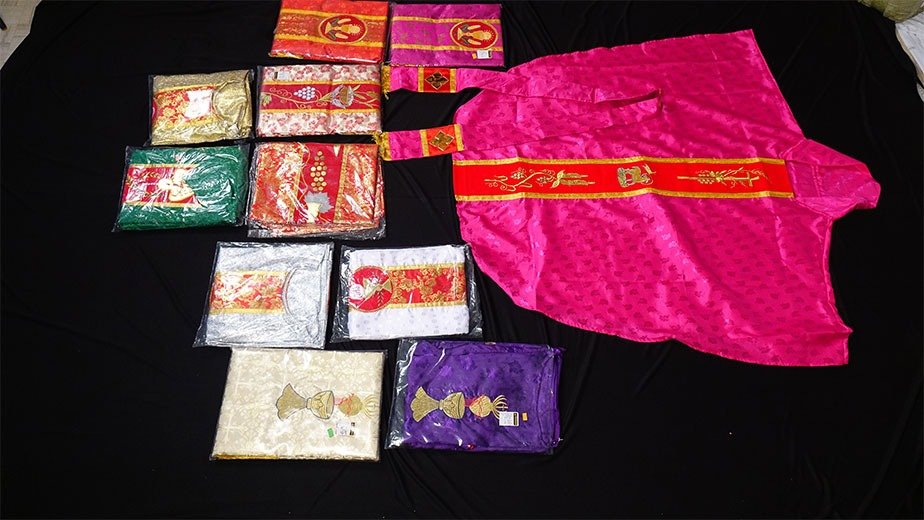
● Amice The first vestment worn by the priest, amice, is a square piece of cloth with two cords attached that goes around the priests’ neck and covers his collar. It is usually tucked into the collar and covers the shoulders while the cord is tied around the chest. It is not a mandatory piece of clothing but it has its own practical uses. It symbolizes the moderation of words and defends against the temptations of the devil. While putting the amice on, the priest prays the following: “Place, O Lord, the helmet of salvation upon my head, to repel the assaults of the devil.” ● Alb Alb is a long white robe that symbolizes the purity of soul required for Mass, as well as the garment used by Pilate to clothe Christ. Altar servers, lectors and priests wear albs when serving at Mass. The priest prays the following while putting on the alb: “Cleanse me, O Lord, and purify my heart … that washed in the Blood of the Lamb … may attain everlasting joy.” ● Cincture Over the alb, the priest wears a cincture which is worn as a belt usually made of cord or rope. It symbolises the virtue of purity. He prays, “Gird me, O Lord, with the cincture of purity and quench in me the fire of concupiscence; that the virtue of continence and chastity may remain in me” as he puts on the cincture. It is usually white but it differs depending on the liturgical season or the colour of the day. White, violet or black are the colours permitted to be worn at funerals and the priest vestment is decided accordingly. ● Stole The stole is an article of immense importance and value, which more than any other garment demonstrates the dignity of ordained office. The stole is a long piece of cloth worn over the neck and falling down the front of the priest’s chest. It is symbolic of the spiritual authority of the priest, and so it is what is primarily worn to signify priesthood. This becomes the major reason why the stole is worn for everything (including confessions, exorcisms), and most priests carry one with them in case they need it for an emergency baptism. And like a cincture, the colour of the stole depends on the liturgical season or colour of the day. These are widely available at Christian stores. ● Chasuble The outer and the last of the priest vestments, Chasuble comes in different designs and shapes. Like cincture and stoles, it must be worn to suit the occasion or purpose i.e., the colour must be of the proper liturgical season (green for ordinary times, purple for advent and lent, gold or white for feasts, etc). A chasuble represents the charity that is required for the priests and symbolizes the virtue of charity. While putting the chasuble on, the priest prays, “O Lord, Who hast said, My yoke is easy and My burden light; grant that I may be able so to bear it, that I may obtain Thy grace. Amen.” Each of the vestures have its own significance, order and symbolism. Priests put them on as per various liturgical seasons, colours and order. Bishops and priests present themselves during the celebration of the mass wearing sets of liturgical vestments. The five liturgical colours (green, red, gold or white, rose and purple) have symbolisms and purposes which are unique. These are to be found or can be bought from any Christian stores. The leading Christian stores in Kerala, one being La Corona Del Rosario, are popular for their range of priest vestments and its quality. If one is searching for priest vestments online or offline, head over to https://lacorona.in/product-category/clergy-apparel/ to easily scroll through their vestment collections.
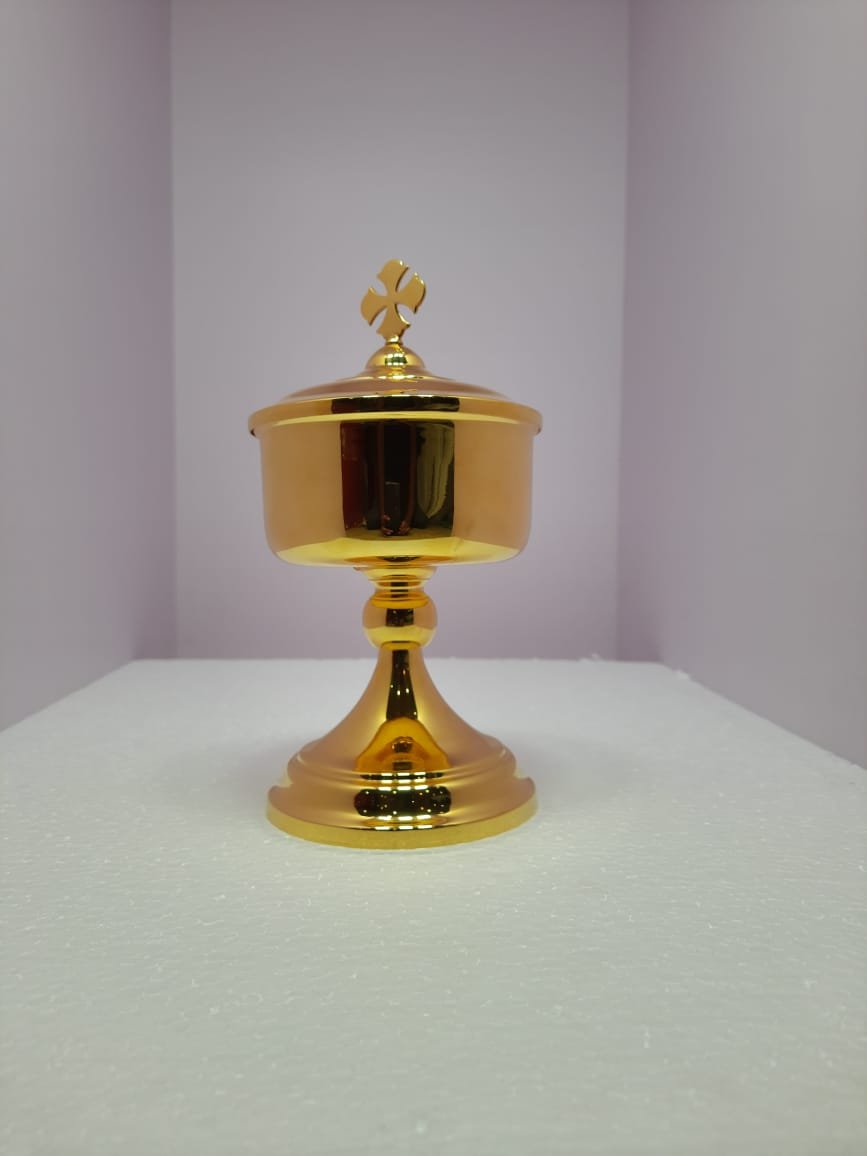
“Like a branch that grows because of its connection to the tree, we thrive when we stay connected to the church.” Church articles comprise the various important elements, each with its own significance, in worship like the holy chalice, ciborium, incense pot, mass kits, and traditional lamp/nilavilakku, to name a few. What makes it a crucial part of their life? Let’s get into the reasons why these church articles are vital for every Christian: The sacred vessels used in liturgical celebrations are the receptacles and utensils used to hold the consecrated Body and Blood of Christ. In the Latin Rite of the Roman Catholic Church, such vessels are Chalices (golden or silver), Patens (pewter or wood), Ciboria (wooden boxes), Pyxes (silver or gold boxes), and Monstrances (frontal vessels). The chalice functioned as a vessel holding consecrated wine during the Christian tradition of communion, during which it was believed that the Eucharist and wine became the body and blood of Christ. In ecclesiastical life, the priest uses this chalice at mass to serve the wine to his congregation. This chalice and paten, or plate, were made to hold the consecrated wine and bread used during the Eucharist, also known as the Mass, considered to be the central service of Christian worship. At La Corona Del Rosario, one of the most popular Christian stores in Kochi, you get to choose your desired sacred vessel and church articles at our store or while sitting in the comfort of your home. Gold is an object with roots strongly connected to many cultures and religions, representing both spiritual and powerful significance. In Christianity, gold was used to symbolize the connection to the Holy Spirit in the form of reliquaries. Relics are considered to hold more value than precious stones and carry more esteem than gold, for they possess historical significance and hold a relic of a saint or martyr. As kids, we were accustomed to lighting candles in the church. There lies a huge meaning for this practice. Altar candles and altar linens, along with chalices and ciboriums, play an important role in the liturgy. Candles banish darkness, reminding worshippers of the greatness and magnificence of God’s Love. Altar candles vary in color, depending on their liturgical period, and can be green, red, or purple. All these lights are a symbol of victory over death and are often used together with candles during worship services. Not to forget the paschal candles: the Paschal candle is the first candle to be lit during Easter Sunday Mass, representing a light that comes into the world. This symbolizes Christ’s resurrection, which signifies a time of life and growth when darkness has been dispelled by light. These candles are readily available at La Corona Del Rosario, the trusted Christian store amongst all, both online and offline. Yet another important Christian article is the bells which come with two purposes: Church Bell & Easter Bell. They are traditionally used to call worshippers to church for a communal service and to announce the fixed times of daily Christian prayer. Church bells stop ringing on Good Friday and are silent from the beginning of Holy Week until Easter when they ring again at the end of their journey in St. Peter’s Church in Rome. Tradition holds that they then return to their church and spread the news of Jesus’ Resurrection from the bell tower to the bell tower. Bells in a church are rung for various ceremonial purposes and you get to choose from gold/silver plated bells, brass bells, or the traditional wooden Easter bell from the most visited Christian store in Kerala, La Corona Del Rosario. Talking of bells and candles, let’s get into the details of the menorah, a word derived from the Hebrew which translates to the lamp. The seven lamps on a menorah symbolize the branches of human knowledge, represented by the six lamps leaning inwards towards, and guided by, the central lamp—God. The seven-branched menorah also symbolizes the creation in seven days, with the center light representing the Sabbath. Our executive will guide you throughout the process of selecting church articles from our Christian store. The above listed are a few of the many church articles displayed at our Christian store in Kochi. Our head office is situated at Koonamavu, Ernakulam and we have a branch at Varapuzha, Kochi. We proudly carry the tag of La Corona Del Rosario being the leading offline & online Christian store in Kerala with more than 4,000 products to choose from and a loyal customer base from around the globe. We are committed to delivering purest & top-notch articles and church supplies while keeping the welfare of society in mind. Hence, our initiative to work closely with women, retired and housebound people to help us in the process of making & selling church articles, rosaries, and vestments. Come visit our store to learn more about the same and to choose the best church articles & supplies.
Ravi Jose is one of the leading dealers of rosaries in Koonammavu, the nursery of rosary-making in Kerala, as well as India Photo by Mithun Vinod By Shevlin Sebastian Fr. Sanal Lawrence D’Souza is like a kid in a toy shop. At the La Coruna Del Rosario shop at Koonammavu, 17 kms from Kochi, he picks up numerous rosaries, Bibles, sepulchers, candles, key chains, statues of Jesus Christ, as well as Crucifixes. The jean-clad priest has come from the St. Theresa’s Church at Mahe, 240 kms away. “We have a feast coming up in October for our saint,” says Fr. D’Souza. “Lakhs of people are expected to attend. So I am buying all this stuff to be sold there.” And the man who is selling the material is Ravi Jose, who is one of the leading dealers of rosaries in Koonammavu, which is regarded as the home of rosary-making in Kerala, as well as India.
His passion for finding the perfect beads has made Ravi Jose one of the leading dealers of rosaries in Koonammavu, the hub of rosary-making in Kerala as well as India.
Koonammavu is a small village on the NH 17 a few kilometers to the north of Kochi. This village, however, is on the global business map, thanks to a cottage industry – rosary-making.
People of Koonammavu proudly call their village ‘little Rome’ as it ships the prayer beads all over India and abroad. “Wherever there are Christians, there are rosaries from Koonammavu,” claims Ravi Jose Thannikot, who owns a shop that sells rosaries and other items of religious use.
Mr. Thannikot is one of Koonammavu’s many entrepreneurs who procures beads, thread and wire from parts of North India and supplies them to women in the village. The women return finished rosaries for a pay and these are sold locally or exported by him. Mr. Thannikot says around 2,000 women from Koonammavu and surrounding areas bring him finished rosaries. Twelve women are employed full-time on his staff too.